


Searching for ways to inspect another person’s Instagram likes brings up two very different kinds of promises. Some services explain that they report selected public activity. Others imply that a dashboard can reveal hidden interactions or bypass account privacy. For a security-conscious reader, those claims should not be treated as equivalent.
People who want to see what people like on Instagram should evaluate the threat model before choosing a product: What information is actually available? Must they provide Instagram credentials? How complete are the results? And what conclusions can the data reasonably support?
Two services worth comparing are Snoopreport and DolphinRadar. Both focus on public Instagram activity, but their plans and reporting options differ. Neither should be mistaken for a way to access private messages or private profiles.
First, Define the Security Risks
A request for your Instagram password is a meaningful risk, particularly if the advertised feature concerns another person’s account. The US Federal Trade Commission explains how phishing scams try to obtain personal information and account credentials. That does not establish that either service discussed here is malicious; it explains why credential handling belongs in any evaluation.
Other risks are less dramatic but still important: confusing inferred interests with facts, assuming an incomplete report is comprehensive, or misreading an observation date as the exact time of an action.
An honest comparison must separate what the services say they detect from what Instagram itself makes visible.
Snoopreport: What It Does and How It Works
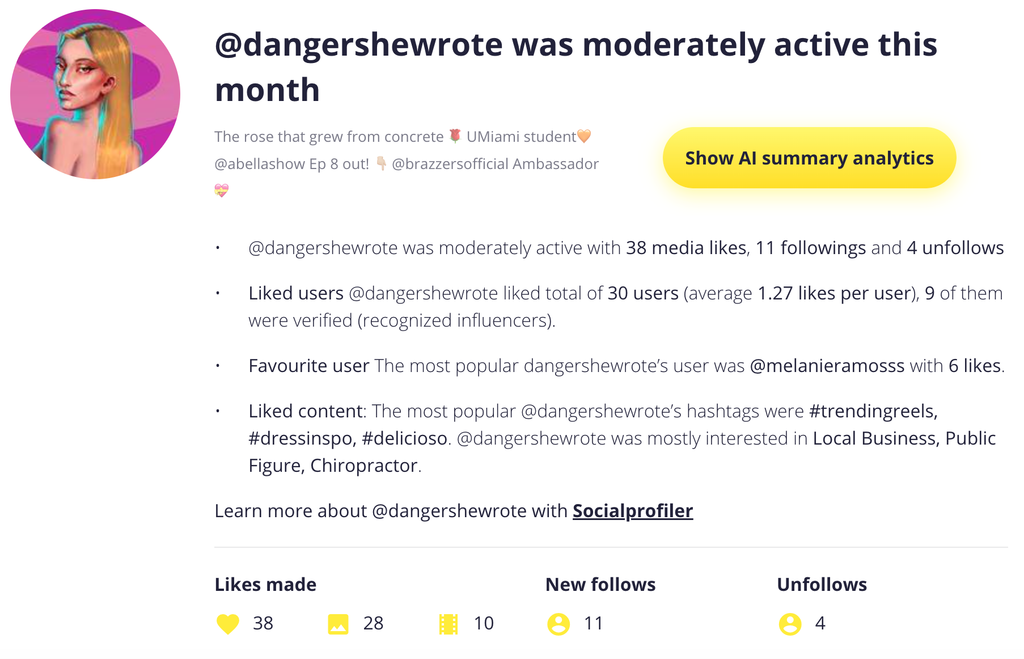
Snoopreport is an Instagram activity tracker for public accounts. It organizes detected likes, follows, and unfollows into weekly or monthly reports. Users add an eligible public username and review available activity without providing an Instagram password.
For someone examining public engagement patterns, the main benefit is having observations grouped by reporting period instead of manually searching individual posts.
The optional AI Summary feature interprets recurring themes in reported activity. It can also suggest date ideas and conversation starters when the observed interests relate to food, travel, or entertainment. Those suggestions are interpretations of incomplete data, not verified descriptions of a person’s preferences.
Snoopreport states that its coverage can reach up to 75% of observable public activity. That is a ceiling, not a guarantee for every account or reporting period. It cannot access private messages, private accounts, or story-viewing histories.
Snoopreport Pricing
Its published monthly plans are $4.99 for two accounts, $14.99 for ten, and $44.99 for 100. Optional AI features are charged separately, and available historical reports cost $1.19 per account per week.
The two-account entry plan may appeal to people who need more than one profile, but users should verify current billing terms before purchase.
DolphinRadar: The Alternative

DolphinRadar also markets public-account Instagram activity monitoring without requiring the target account’s password. Its social-insights offering includes reporting on available likes and follow-related activity, with weekly summaries and downloadable data options.
That makes it a relevant competitor rather than a fundamentally different category of tool. Its appeal depends on whether a buyer prefers a single-account plan or specific export and analysis features.
DolphinRadar lists a Standard Social Insights plan at $4.49 per month for one account, with quarterly and annual options. It also sells a separate Recent Follow Tracker, listed at $6 per month or a lower monthly equivalent on an annual plan. These are distinct products; pricing for one should not be presented as including all the other’s capabilities.
As with Snoopreport, a public-account reporting claim is not a promise of complete coverage or exact knowledge of why someone engaged with a post.
Security and Feature Comparison
| Question | Snoopreport | DolphinRadar |
| Instagram password required for public tracking? | No | No, for its public-account tools |
| Public likes and follow-related insights? | Yes, detected activity | Yes, within relevant social-insights offerings |
| Reporting | Weekly/monthly reports | Weekly reporting and export options |
| AI functionality | Optional AI Summary, including interest-based prompts | AI analysis options |
| Starting listed plan | $4.99/month for two accounts | $4.49/month for one account |
| Private DMs or private-account access? | No | Not a legitimate advertised capability of these public tools |
These figures refer to different account allowances, so the lower sticker price is not automatically the better deal. A one-account buyer and a team tracking several public profiles may reach different conclusions.
What Can Be Checked Without Either Service?
Instagram may show the accounts that liked a particular public post, depending on visibility and interface conditions. That is a useful free check when you already know the post.
It does not provide a complete chronological history of everything another account liked. Screenshots can preserve a dated observation, but they do not reveal every interaction or establish why it happened.
If you only need to see what people like on Instagram on one specific post, the free method is often sufficient. Subscriptions become more relevant when the same research task recurs.
How to Assess the Privacy Claims
First, confirm that the target account is public and that the information you seek is within the provider’s stated scope. A tool promising hidden direct messages should be a warning sign, not a selling point.
Second, distinguish reporting frequency from event timestamps. A weekly report may show that an interaction was detected within a period without establishing the exact moment it occurred.
Third, ask how the service handles billing, retained data, and exports. Password-free tracking removes one credential-sharing risk, but it does not answer every privacy or security question.
Fourth, treat AI interpretations as hypotheses. A summary suggesting restaurant interests may be useful for a conversation; it is not evidence of personal identity, relationships, or intent.
These checks matter whether the use case is consumer curiosity, family conversations about online safety, or professional research.
For a recurring need to see what people like on Instagram, report transparency and credential handling matter as much as the number of detected interactions.
Verdict: Which Tool Makes More Sense?
For users who want to see what people like on Instagram through organized public-account reports, both products deserve consideration.
DolphinRadar has a slightly lower listed single-account entry price and offers export-oriented functionality. Snoopreport offers a two-account starting plan, weekly/monthly reporting, and optional AI Summary features that may be useful when interpreting interests.
Neither product should be described as a security bypass or a complete archive of another person’s activity. The safer choice is the one whose stated scope, pricing, and data handling match your actual need – without promising access that Instagram does not provide.
