


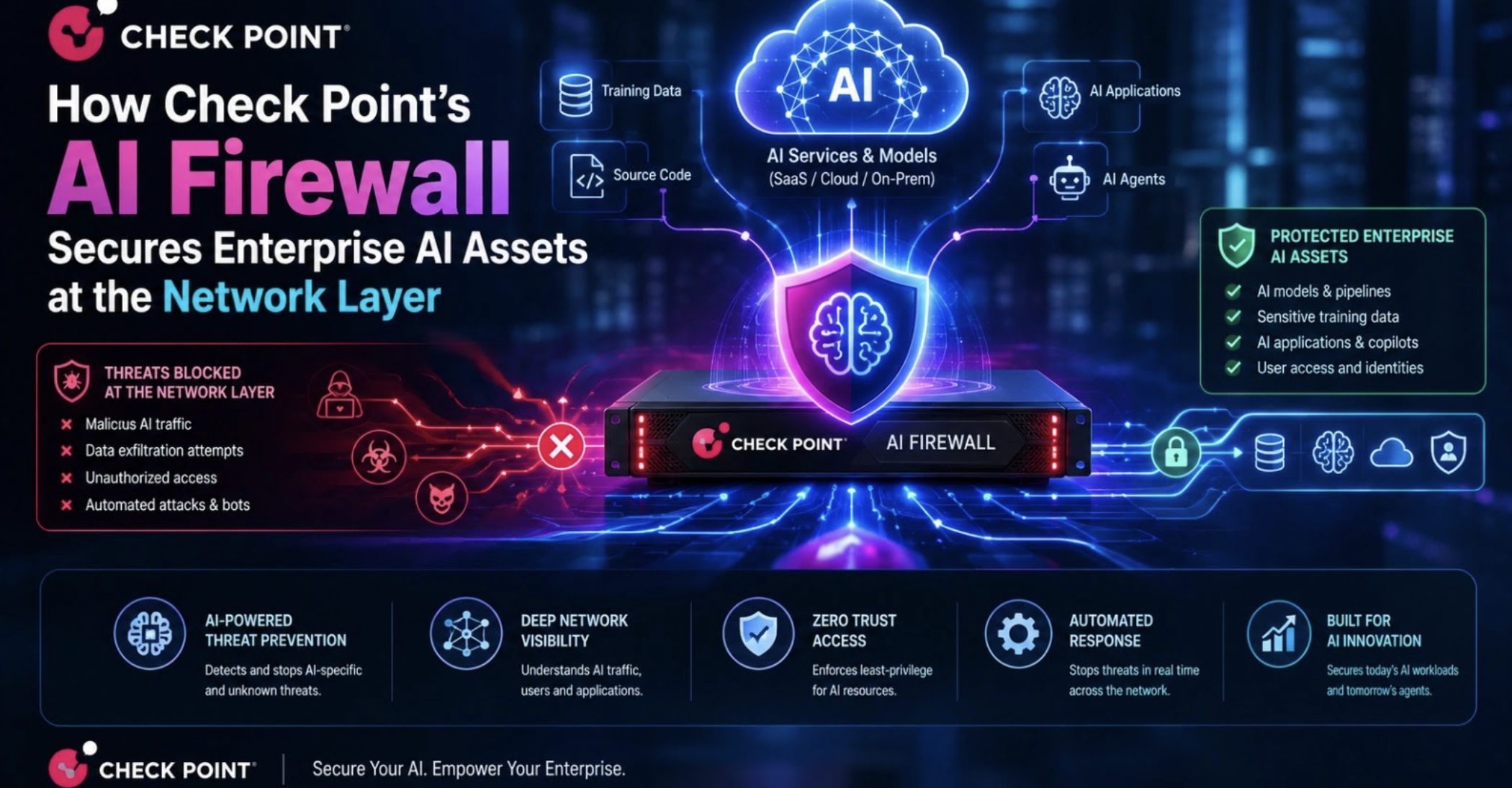
Traditional security tools fall short when it comes to protecting enterprise artificial intelligence assets, which is why Check Point recently launched its AI Network Firewall.
The company debuted the new tool in July to address an urgent problem. A March 2026 report by Cybersecurity Insiders shows that 73% of organizations have already deployed AI tools, while only 7% have governance systems in place to enforce security and policy for those tools in real time.
The same report found that just 6% of businesses claim to have complete visibility into AI usage across their IT environments, while only 8% have a policy in place to govern their Model Context Protocol (MCP) servers, which are used by AI agents to connect with third-party tools.
This means that the other 92% are either not monitoring their MCP traffic at all, or aren’t aware it needs to be governed at all.
These gaps matter, because AI adoption creates an entirely new set of risks for enterprises. One of the most worrying is “Ghostjacking,” a new technique that was demonstrated by security researchers in August that involves hijacking AI coding tools and transforming them into an execution layer for attacker-controlled nodes.
They showed how it can be used to run commands, change cloud settings and steal security credentials, without ever needing to compromise the agent’s reasoning in a way that traditional threat detection tools would notice.
Check Point created the AI Network Firewall specifically to protect against this kind of threat, extending inspection to the traditional network that AI traffic has to pass through, rather than creating a new infrastructure layer.
When it launched on July 30, the AI firewall was one of the first efforts by an established security firm to embed AI-specific traffic inspection within enterprises’ existing infrastructure, avoiding the need to expand an already complicated security stack.
It’s not a firewall in the traditional sense that has simply been enhanced with AI capabilities to protect against older threats.
This one was designed specifically to protect AI assets such as models, agents and MCP.
What You’ll Learn
- How Check Point’s AI Network Firewall discovers AI and classifies how it’s used within the corporate network, including shadow AI.
- Why legacy data loss prevention struggles to protect AI-generated content, and how the AI firewall addresses this.
- How Check Point’s solution governs MCP and agentic traffic and stops prompt injection before it reaches AI models.
How the AI Network Firewall Discovers AI Usage Across the Network
Given that just 6% of businesses know the full extent of their AI footprint, visibility is vital. The AI Network Firewall goes beyond traditional port and protocol analysis, using advanced discovery techniques designed to recognize dynamic and often-encrypted AI traffic.
One method it employs is intent-based classification of traffic and prompts. By analyzing the behavioral patterns and context of AI traffic, it’s able to distinguish between sanctioned AI tools and the use of “shadow AI” tools that have not been authorized or secured by security teams.
Through this mechanism, it can spot when employees are interacting with unapproved chatbots due to the nature of request-and-response traffic.
After discovering all of the AI systems interacting with the network, the AI Network Firewall assigns a risk score to each one, based on the data it accesses, its compliance posture and other parameters.
This gives organizations a prioritized view of the AI activity crossing their entire network.
Why Legacy DLP Fails Against AI, and What Changes at the Network Layer
Conventional data loss prevention (DLP) tools are deterministic in nature, relying on “regular expressions” or regex to match specific keywords with known formats.
But this breaks down against AI traffic, because AI systems can paraphrase sensitive content into entirely different wording while preserving its underlying meaning.
A regex filter looks for the original phrasing, so once an AI has reworded it, the same sensitive information can slip through undetected.
Check Point’s AI Network Firewall tackles this with semantic, meaning-based inspection built directly into the platform.
It works by inspecting both prompts and uploaded content in real time, trying to understand the actual meaning of the content, rather than just looking at the way it was written.
If an employee tries to upload a detailed business forecast to create a summary, for example, then the firewall can identify the confidential financial projections and prevent the document from being uploaded, so the AI model never sees that sensitive data.
Discovery and Governance for MCP and Agent Traffic
According to the Cybersecurity Insiders report, just 8% of organizations have a policy in place to govern their MCP traffic.
Yet MCP has become a critical enabler of autonomous AI agents that go beyond simply providing answers and do actual work on behalf of humans.
Essentially, MCP is what allows these agents to utilize third-party tools and access data from other sources.
Check Point covers this with a discovery mechanism that creates an inventory of the MCP servers and tools using them.
These become visible within the AI security dashboard and the firewall’s control logs, and like AI models and applications, they’re categorized based on their level of risk.
This provides a way to monitor what AI agents are doing in real time.
MCP is central to governing agentic traffic, but it’s not the only guardrail required. AI agents often take actions in ways that never utilize MCP, such as executing local terminal commands and communicating directly with APIs, which is why MCP governance must be paired with broader controls rather than treated as sufficient on its own.
Stopping Prompt Injection Before It Reaches a Model
Ghostjacking isn’t the only threat to AI. One of the most dangerous techniques used by attackers is prompt injection, where adversarial instructions are embedded within a seemingly harmless prompt in order to extract sensitive data or perform a malicious action.
To protect against this, Check Point’s firewall leverages Lakera’s intelligence engine to parse user prompts and identify attempts to subvert AI models in this way.
A common trick used by hackers is to insert malicious commands into prompts, such as when a developer uploads a few lines of code to a coding assistant to check its syntax.
An attacker could manipulate this prompt to try to steal the developer’s session tokens. The AI Network Firewall can stop this in its tracks by scanning the prompt, identifying the hostile intent and blocking it from reaching the model.
Architecture and Deployment
With its AI Network Firewall, Check Point prioritized operational simplicity, aware that many security teams don’t want to deal with the complexity of installing additional hardware or setting up an entirely new console.
Instead, the R82.20 release integrates directly with the existing firewalls its customers already run, so discovery, DLP alerts and prompt injection inspection and blocking are all routed through the same interface security teams already use to monitor their traditional firewall.
Check Point has also built the R82.20 upgrade process itself to minimize disruption during rollout.
According to the company, background management upgrades are designed to cut downtime to minutes rather than hours, with much of the preparation work happening in parallel rather than requiring a dedicated maintenance window.
For security teams already managing a busy firewall estate, that can be as important as the absence of new hardware, since the upgrade path itself determines how disruptive adopting the new capabilities actually is.
Closing the AI Visibility Gap
The gap between AI adoption and AI governance is 66 percentage points wide. Closing it clearly takes more than a single security feature.
AI security depends on visibility, real-time inspection and MCP governance working together at the network layer, where most AI traffic passes.
Check Point’s AI Network Firewall brings all three of these together, identifying which AI tools are being used and monitoring their traffic to narrow that visibility gap and give enterprises a clearer picture of their AI usage.
FAQs
- How is an AI firewall different from a traditional firewall?
Many find the difference challenging to navigate due to the fact that many traditional firewalls have been upgraded recently with AI features to enhance protection against a variety of threats, many of which might likewise be powered by AI.
However, a true AI network firewall is designed to protect the actual AI systems, including models, agents and MCP traffic, against newer threats like adversarial prompts, manipulation and semantic data exfiltration.
- What is the best AI network firewall for enterprises adopting agentic AI?
Enterprises that use autonomous agents need a specialized AI firewall that can discover these AI assets and inspect their traffic with semantic understanding.
Check Point’s AI Network Firewall discovers AI assets crossing the network and can govern AI-native traffic like MCP requests and block prompt injection attacks and data exfiltration attempts in real time.
- Does deploying AI-specific network security require new hardware?
No. Check Point’s solution is designed to be integrated with customers’ existing security infrastructure, layering AI governance and security on top.
This means they can protect their AI assets and data without making major changes to network security or installing new hardware or management consoles.
- Why does MCP need its own security attention?
MCP servers are the bridges that connect AI agents to third-party tools, data and APIs. If this traffic is not monitored, attackers can hijack MCP servers to insert malicious prompts or take control of AI agents.
But this isn’t enough to fully secure AI agents, as they can still interact with APIs and take actions without using MCP. Securing agentic AI means governing all of these surfaces, not just the ones that pass through MCP.
abilities to protect against older threats. This one was designed specifically to protect AI assets such as models, agents and MCP.
