Malware Authors started using web browser extensions as an attack surface to distribute malware to steal credit cards and other banking details.
Researchers observed a new dubbed Mispadu aimed to steal monetary details from the users. The malware is written in Delphi language and targets customers in Brazil and Mexico.
Mispadu is a custom malware that aimed at collecting the following information from the victims. The details include the following such as;
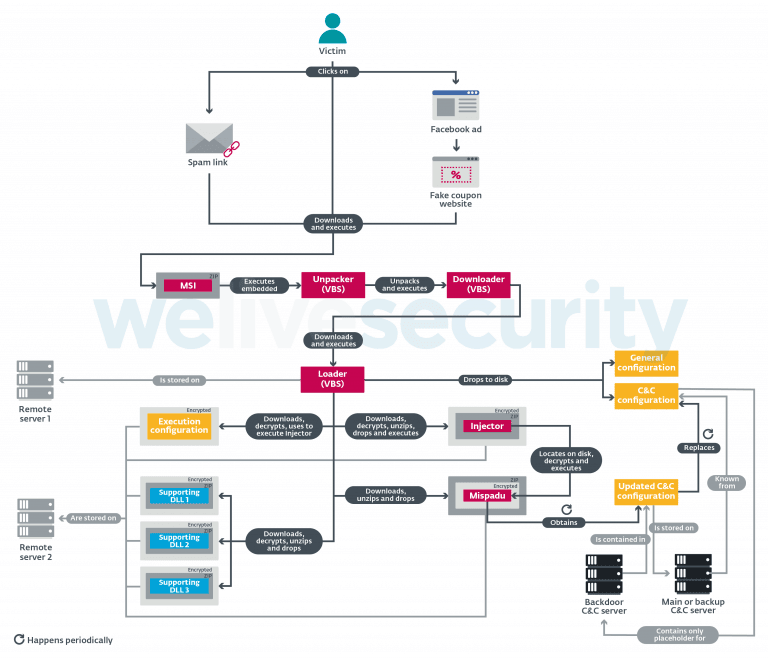
The malware employs two common distribution methods of distribution such as spam and malvertising. Threat actors used Facebook as an advertisement medium offering fake McDonald’s coupons.
Upon clicking coupon links users are taken to a malicious page that downloads a malicious MSI file, regardless of user operating system. The malware infection chain varies between the country, but the logic remains the same.
Following the MSI file it downloads three VBS loaders, the first script unpacks and executes the second script which downloads and executes the third script which is the loader.
The loader script checks for the infected victim machine language and checks whether the script executed in the virtual environments if the virtual environment detected then it quits execution.
If the infected machine is not a virtual machine then it continues by setting up configuration files and downloads the following files as separate ZIP archives.
To maintain persistence it creates a link in the startup folder and executes the injector.
According to ESET analysis on the malware campaign that targets Brazil, the campaign produces more than 100,000 clicks from Brazil itself and they found to be originated from Facebook.
The threat actor uses social media such as Facebook to show fake McDonald’s discount coupons. The fake coupons found to be downloaded form Russian Yandex.Mail platform. ESET said that “the operators created an account on Yandex[.]Mail, sent an email with the malicious coupon as an attachment to themselves and then pointed the potential victim to a direct link to this attachment.”
Another way of distribution is through the malicious chrome extension, in this campaign attackers used a malicious chrome extension “Protege seu Chrome” (translation: “Protect your Chrome”) to distribute the malware.
The distribution method differs here, but the infection chain remains the same.
The chrome extension capable contains following components to steal data from the victim machine
The primary goal of this attack campaign is to steal financial details from victims and the campaign primarily targets users in Brazil. Complete list of Indicators of Compromise found in GitHub repository.
You can follow us on Linkedin, Twitter, Facebook for daily Cyber Security and hacking news updates.
Also Read
Hackers Hosting Fake Military Veterans Website to Drop Malware
NSA, CISA, and NIST have released joint security guidelines to help organizations detect, contain, and…
Hackers are exploiting a command injection flaw in SiteGuard Server Edition, a web application firewall…
A newly registered domain copies Microsoft Teams’ login page and interface, raising concerns about a…
A 16-year-old flaw in Broadcom’s Wi-Fi software can let attackers within wireless range take control…
Google has announced a new set of Android security protections designed to stop mobile scams…
Hackers are exploiting flaws in Plex Media Server to install cryptocurrency mining malware, with a…